Open Badges for skills recognition
Why Open Badges make demonstrated skills portable and understandable — and how verification keeps skills claims honest.
OPEN BADGE VALIDATOR · Oct 16, 2026
A skill only counts beyond one workplace when the next person can understand and check the claim behind it — exactly what an Open Badge is designed to carry. With criteria, evidence and issuer data embedded in a verifiable credential, anyone can confirm a skills badge in seconds using a free Open Badge checker.
That is the premise. This article is about making it work in practice: why ordinary skills claims fail the moment they leave the building, what a well-made skills badge actually contains, how to name and assess skills so the badge means something, and what the person on the receiving end — usually a recruiter or a manager — should check before believing any of it.
The trouble with skills claims
The working world runs on skills claims, and almost none of them can be checked. A CV says "proficient in data analysis"; a LinkedIn profile lists forty endorsed skills; an internal HR system records competencies self-reported in an annual review. Each claim costs nothing to make, which is precisely why none of them is worth much to read:
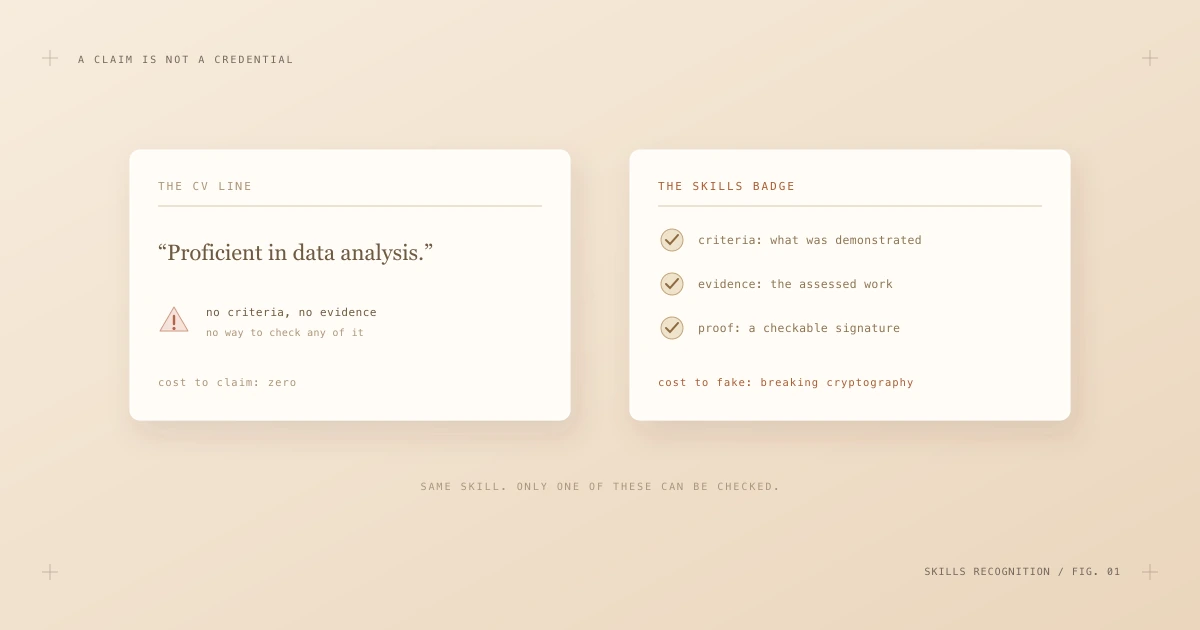
Fig. 1 — The same skill, stated two ways. One costs nothing to claim; the other costs breaking cryptography to fake.
Organizations compensate with expensive proxies. Degrees stand in for skills they only loosely imply. Interviews re-verify, badly and inconsistently, what someone already demonstrated elsewhere. Take-home tests ask candidates to prove, for the fifth time, a competence that four previous employers already observed. The waste is enormous, and it lands hardest on people whose skills were built outside formal education — precisely the people skills-based hiring is supposed to reach.
The structural problem is that the claim and the proof are separated. The claim travels (on the CV); the proof stays behind (in a former employer's memory, a closed LMS, a finished project). An Open Badge is, at its core, a container that welds the two together: the claim travels with its proof attached, in a form machines can check.
What a skills badge actually carries
A skills badge is not an image with a caption. Under the artwork sits a verifiable credential whose payload is engineered to answer the exact questions a skeptical reviewer would ask:
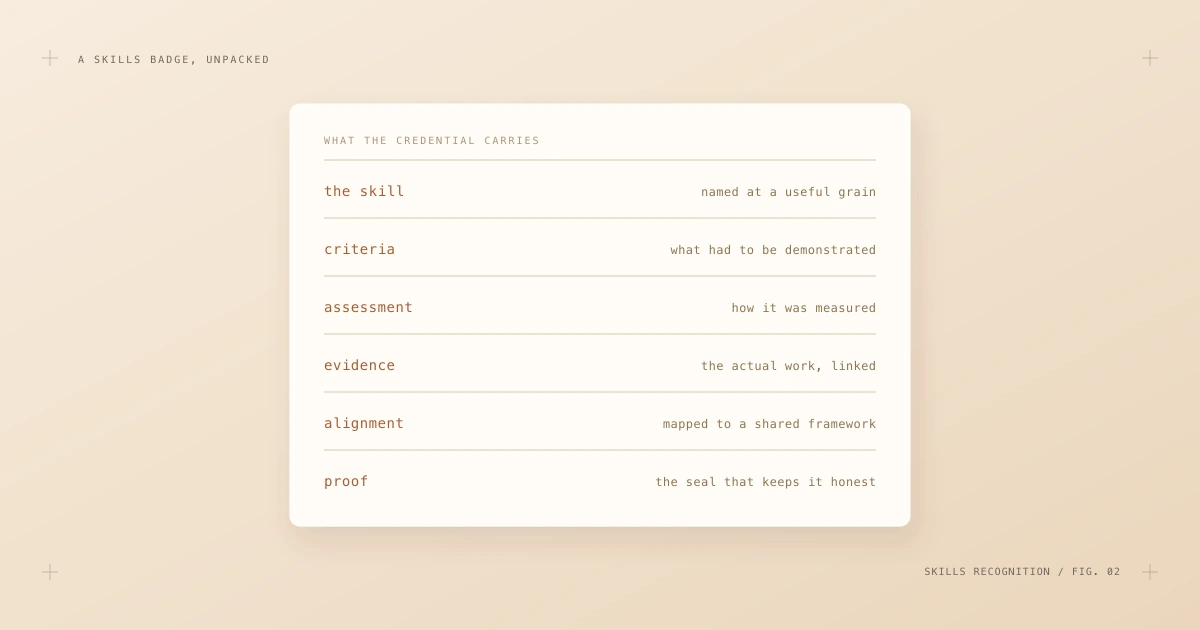
Fig. 2 — Skill, criteria, assessment, evidence, alignment, proof. Each field answers a question a reviewer would otherwise have to ask in an interview.
- The skill itself — named precisely, at a grain that matches how people actually hire (more on this below).
- Criteria — what the earner had to do, written for a stranger. "Completed the course" is attendance; "cleaned, analyzed and presented findings from a real dataset, assessed against a rubric" is a skill.
- Assessment — how the demonstration was measured, and by whom.
- Evidence — links to the work: the project, the submission, the review. Optional in the spec, decisive in practice.
- Alignment — a machine-readable mapping to a published skills framework, so systems can compare badges from different issuers.
- Proof — the cryptographic seal that makes all of the above tamper-evident and independently checkable.
The discipline this imposes on issuers is healthy: if you cannot fill in criteria, assessment and evidence honestly, you have discovered that you are about to badge attendance, not skill — better to find out before the credential ships than after a recruiter does.
Name the skill at the right grain
The most common design failure in skills badging is granularity. Make badges too small and nobody cares; too large and nobody believes:
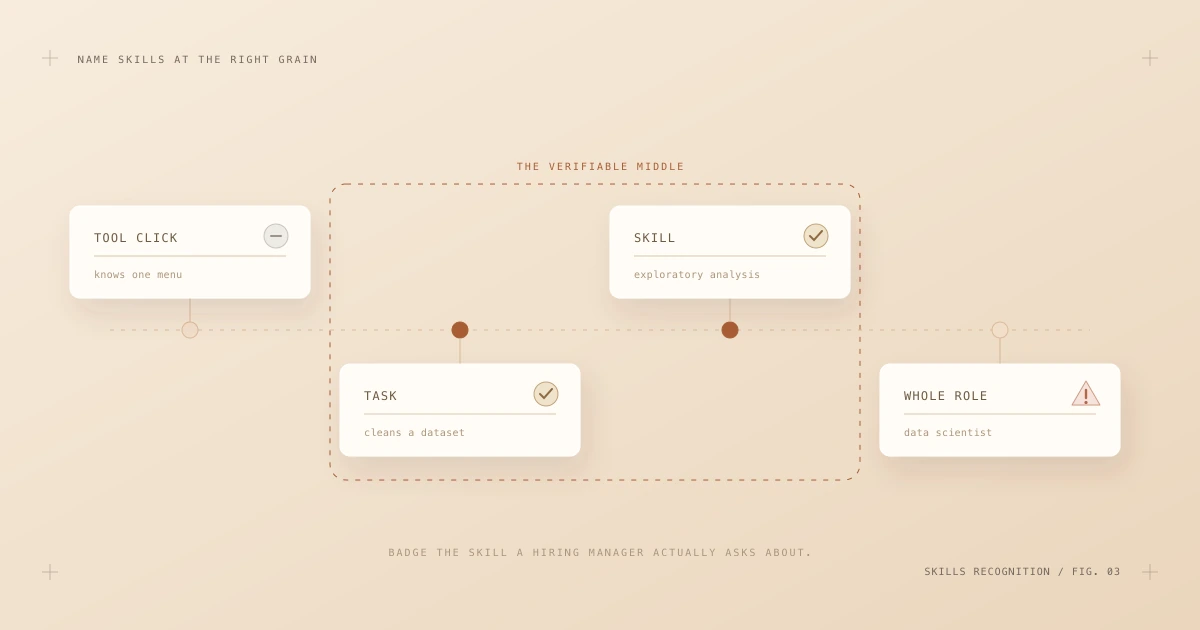
Fig. 3 — Too small to matter, too big to verify — and the verifiable middle where skills badges earn their keep.
A badge for "used the filter menu in a spreadsheet" is confetti; a hundred of them communicate less than one good credential. At the other extreme, a badge claiming someone is a data scientist asserts an entire role — something no single assessment can honestly verify, which makes the badge either dishonest or meaningless.
The verifiable middle is where skills badges work: a task or skill a hiring manager actually asks about, demonstrable in one assessment, nameable in the words the market uses. "Exploratory data analysis." "Incident triage." "Workshop facilitation." The test for the right grain is concrete: can you write criteria for it that one assessment can genuinely cover, and would a job posting mention it by name? If a competence is genuinely bigger than that, issue a set of badges and let the collection tell the larger story — collections can be verified; adjectives cannot.
Speak a language others already know
A skills badge from one issuer is useful; a thousand issuers each inventing their own skill names is a new Tower of Babel. The Open Badges alignment field exists to prevent exactly that — it maps your achievement onto skills frameworks the rest of the world already uses:
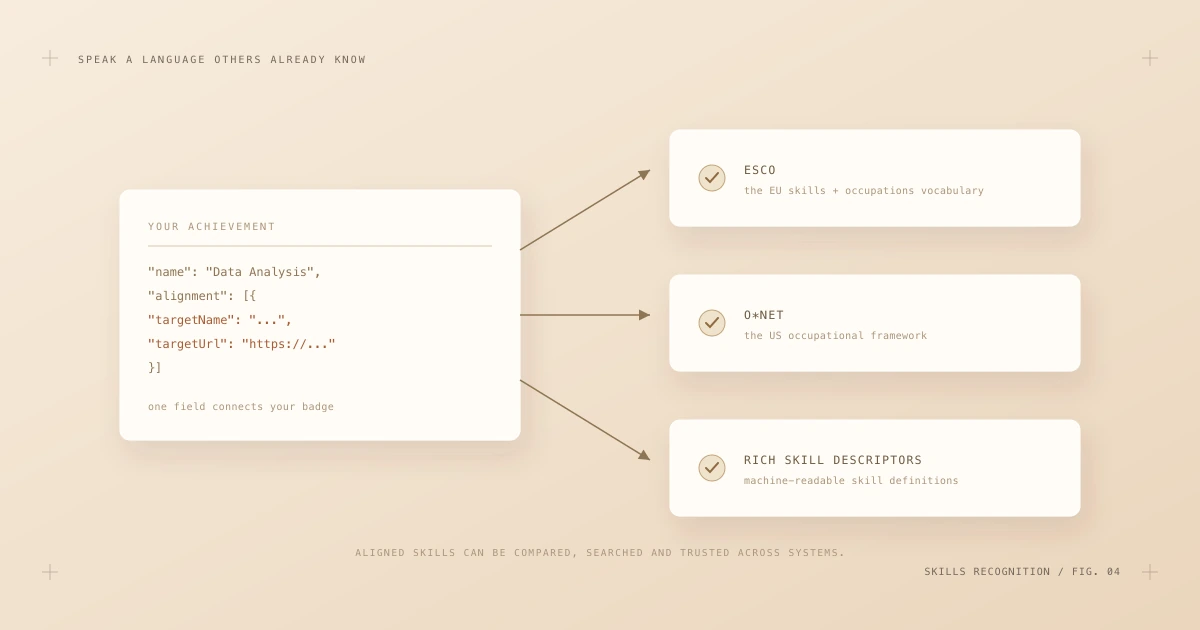
Fig. 4 — One alignment entry connects your badge to vocabularies that employers, governments and software already understand.
In credential form it is a few lines:
"achievement": {
  "name": "Exploratory Data Analysis",
  "alignment": [{
    "type": ["Alignment"],
    "targetName": "data analysis",
    "targetUrl": "https://esco.ec.europa.eu/en/classification/skill/..."
  }]
}
The targets worth knowing: ESCO, the EU's multilingual classification of skills and occupations; O*NET, the US occupational framework; and Rich Skill Descriptors, machine-readable skill definitions designed specifically for credential alignment. Industry bodies publish narrower frameworks for their own domains.
Alignment is what turns a pile of badges into data. An HR system that has never heard of your organization can still place your badge on a skills map, aggregate it with credentials from other issuers, and match it against a role profile — because the badge points at a definition everyone shares. For issuers it also sharpens design: forcing each badge to align with a published framework is a fast way to discover which of your planned badges are real skills and which are internal jargon.
Assessment is the product
Two badges can carry identical skill names and be worth wildly different amounts — because what a skills badge is really certifying is the assessment behind it:
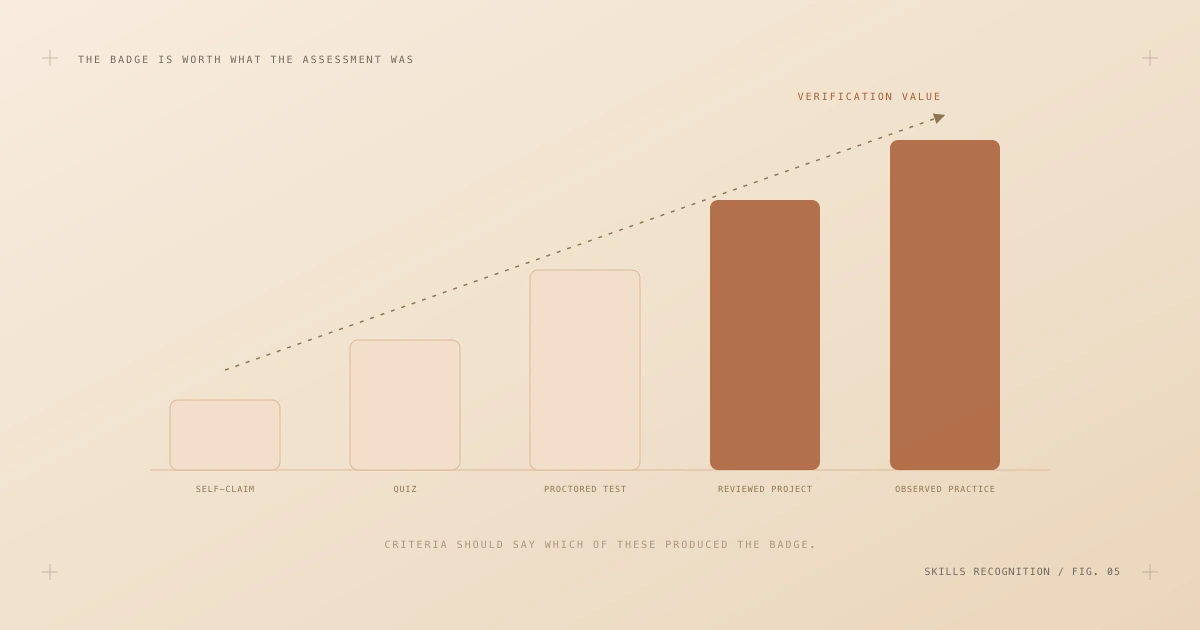
Fig. 5 — The badge is worth what the assessment was. Criteria should say, plainly, which of these produced it.
The scale runs from self-claim (worth what it costs: nothing), through quizzes, proctored tests, assessed real-world projects, up to observed practice over time. Nothing on the lower rungs is forbidden — a quiz-backed badge can honestly mark progress inside a learning journey, which is its own valid use case. The sin is not weak assessment; it is undisclosed assessment.
Time belongs on the same scale. Skills decay and tooling moves, which is why serious skills badges carry a validUntil date where currency genuinely matters — instead of pretending a 2019 assessment describes a 2026 capability. An expired skills badge is not an embarrassment; it is the credential telling the truth about time, and a renewal path — re-assess, re-issue — is part of a well-designed program rather than an afterthought.
So the rule for issuers is disclosure: the criteria must say which rung produced the badge. "Passed a 20-question knowledge check" and "shipped a project reviewed by two senior practitioners against a public rubric" are both legitimate sentences — but a reviewer must be able to tell which one they are looking at without an interview. Issuers who blur this distinction are spending their own credibility; reviewers learn an issuer's assessment habits quickly, and they price the issuer's entire catalog accordingly.
From demonstration to decision
Put the pieces together and skills recognition becomes a pipeline rather than a leap of faith:
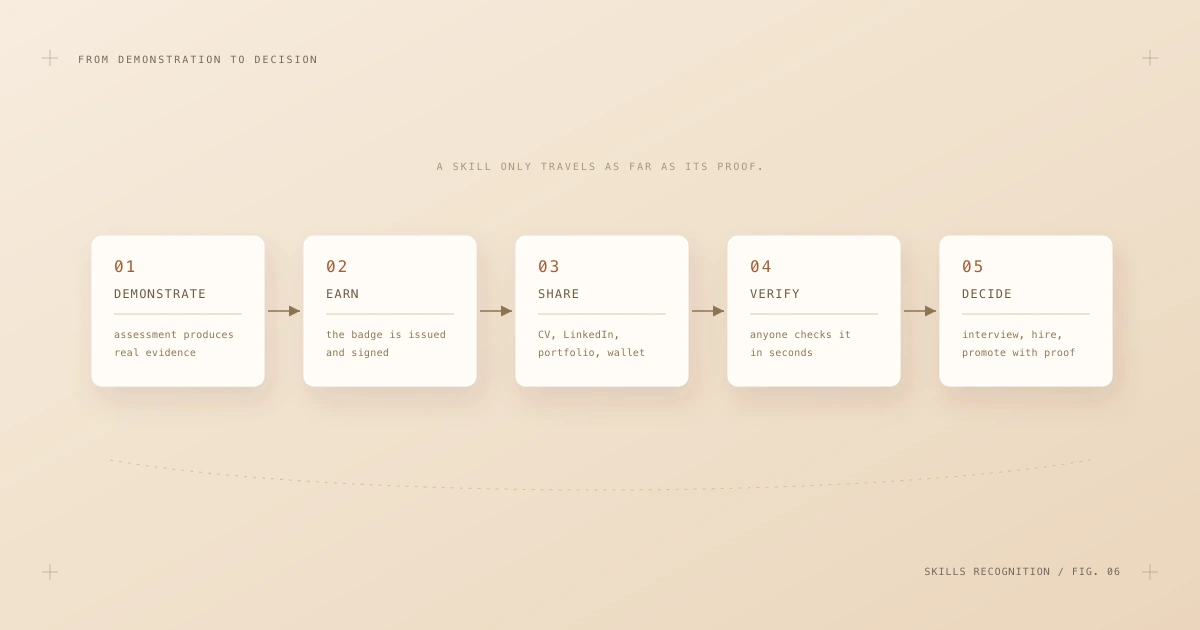
Fig. 6 — Demonstrate, earn, share, verify, decide. The proof travels the whole way; the skill never has to be re-proven from scratch.
The earner demonstrates the skill once, in a real assessment that produces evidence. The issuer signs a credential wrapping that demonstration, built and delivered properly. The earner shares it anywhere — CV, LinkedIn, portfolio, wallet — because the badge is a file and a URL, not a login. A reviewer verifies it in seconds on an independent validator. And then the decision — interview, hire, staff, promote — gets made on checked evidence instead of vibes.
Notice who gains. The earner stops re-proving the same skill at every door, and their credential keeps working even if the training provider later disappears. The issuer's rigor becomes visible, compounding reputation. And the reviewer replaces guesswork with a five-second check. The cost of trust drops for everyone at once — which is the entire economic argument for verifiable skills credentials.
What a reviewer actually checks
If you are on the receiving end — recruiter, hiring manager, registrar — skills badges only help if you actually verify them. The routine takes five minutes the first time and thirty seconds thereafter:
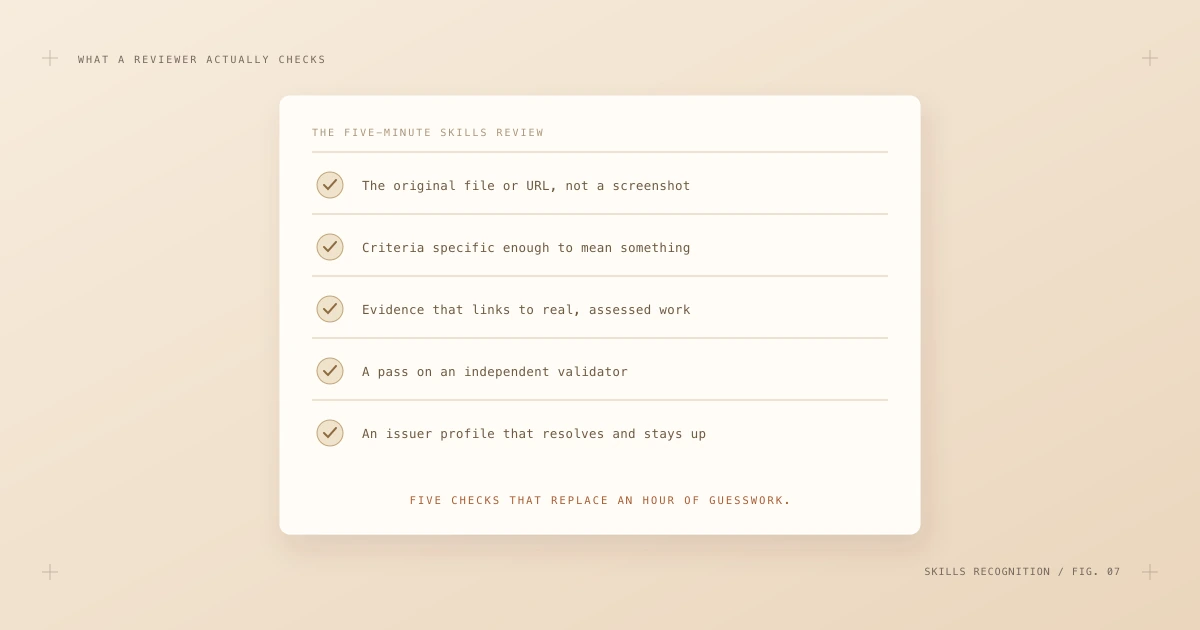
Fig. 7 — Five checks that replace an hour of interview guesswork — and the habit that keeps the whole skills ecosystem honest.
- Get the original — the baked file or the hosted URL. A screenshot of a badge proves the existence of screenshots, nothing more.
- Read the criteria — are they specific enough to mean something, and do they disclose the assessment method?
- Open the evidence — does it link to real, assessed work by this person?
- Run the verification — drop the file or URL into the validator and read the full report: structure, proof, status. Revoked and expired badges fail here, exactly as they should.
- Glance at the issuer — a reachable profile on a stable domain, and ideally a track record of badges that keep verifying.
Reviewers who do this consistently create the incentive gradient the whole system depends on: issuers with rigorous assessment get their badges accepted, issuers of confetti get politely ignored, and candidates learn that verifiable credentials — not keyword lists — are what moves their application forward.
Where skills badges are already working
None of this is theoretical; the pattern repeats wherever skills and formal credentials have drifted apart.
Internal mobility is the quiet success story. Large organizations routinely know less about their own employees' skills than about external candidates', because internal experience never gets credentialed. Badging internally assessed skills — with the same rigor as external ones — turns staffing and promotion into database queries instead of hallway reputation. The same credential then travels with the employee when they leave, which is not a bug: an employer whose badges are respected outside its own walls has built a recruiting asset, not a leak.
Bootcamps and alternative education live or die by skills recognition, since they cannot lean on century-old brand names. A program whose graduates carry verifiable project-based skills badges gives employers something a transcript never could: evidence one click deep, checkable before the first interview.
Workforce development and volunteering may benefit most of all. People re-entering the workforce, career changers and volunteers accumulate genuine, assessed competence that has historically evaporated for lack of a container — coordination, logistics, training delivery, safeguarding. A verifiable skills badge is the first format that lets that experience compound instead of resetting with every application form.
The common thread: skills badges create the most value exactly where traditional credentials have the least coverage — and they do it with the same verification machinery in every case, so none of these contexts needs its own trust infrastructure.
Building a skills-first program
For organizations, the path into skills badging is shorter than it looks, because the hard part is not technology — it is the honesty of the design work above. Name skills at the hiring grain, write criteria that disclose assessment, attach evidence, align to a public framework. The infrastructure — signing, hosting, status lists, delivery — follows the same playbook as any credible badge program, and keeping it trustworthy over the years is a known discipline rather than a mystery.
Most teams do not build that plumbing themselves. Credentialing platforms such as Certifier handle the data model, signing and delivery of standards-compliant Open Badges 3.0, leaving your team the work only you can do: deciding what a skill means in your context and assessing it honestly. The acceptance test never changes regardless of tooling — issue a sample skills badge and confirm it passes a neutral validator before the first real one ships.
Start narrow. Three skills your organization genuinely assesses, badged rigorously, will teach you more — and build more trust — than a taxonomy of fifty launched in a quarter. Skills recognition is a reputation system, and reputations are built credential by credential.
Skills that travel
The promise of skills recognition has always been mobility: that a capability proven once, anywhere, could count everywhere. What was missing was not goodwill but machinery — a way for the proof to travel with the claim and survive scrutiny from strangers.
That machinery now exists and is boringly reliable: criteria and evidence welded into a signed credential, aligned to shared frameworks, verifiable by anyone in seconds. What remains is adoption with standards — issuers who badge real assessment rather than attendance, and reviewers who check rather than skim. Where both habits take hold, something quietly transformative happens: skills stop being claims on paper and become assets that travel — portable, durable, and worth exactly what they can prove.